
Garden
Welcome to the Gloucestershire Heritage Hub community garden!
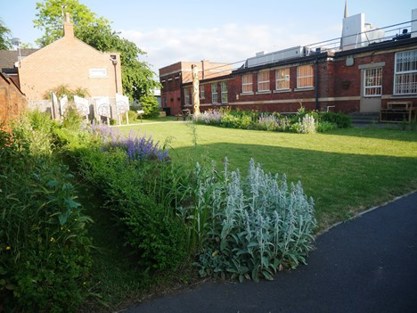
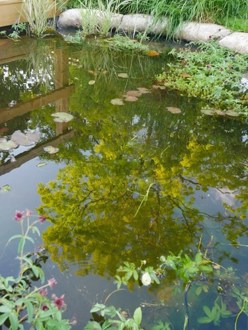
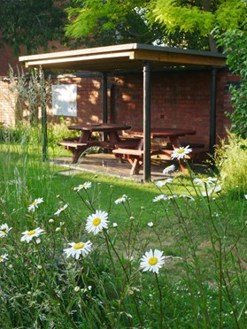
We'd love for you to come and visit the garden! You can find it at the Heritage Hub, Clarence Row. The site is open between 9 and 5 every weekday. Drop in on your way into town; grab a takeaway coffee and relax on one of our benches; you can even play some of our garden games - anyone for giant Jenga? There's lots to see including a wildlife pond, wildflower meadow, beehives, and some amazing original art.
Grow With Wiggly at the Gloucestershire Heritage Hub

Project Grow are teaming up with Wiggly Charity in a bid to grow 50% of the vegetables used in Wiggly’s Gloucester cookery courses and shared with the community of Kingsholm by utilising the space with the existing community garden at the Heritage Hub. We are working to prove the case for a more sustainable community food system growing chemical free plants and produce with low food miles (less than 0.5miles from Hub to kitchen) and all with zero packaging and waste.
To ensure the Kingsholm community benefits from the growing space, its plants and produce, we will be working with the Heritage Hub during 2024 to raise the profile of the project by running events and workshops to promote its availability for people to access. We will also be looking to recruit volunteers to help run the growing space, harvest, and deliver produce weekly to the Wiggly Kitchen in Westgate Street. We will be launching to the community on Earth Day – May 4th, 2024, where we will be showcasing the project and its intended impact and Wiggly will be cooking up food for the community to enjoy.
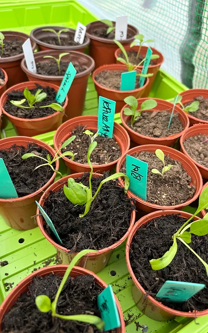

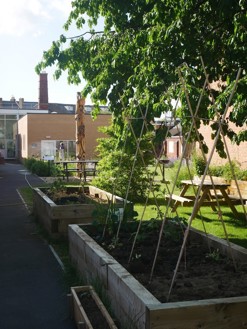
Project Grow is a social enterprise plant nursery + growing space that provides plants and produce to community organisations that feed their local communities, to food banks, food pantries and other food projects. We believe growing food for self and others is an act of rebellion. We grow seasonal plants and produce without the use of herbicides, pesticides, and any other chemicals. We only use peat-free soil, grow in raised and no-dig beds and ensure we follow mother nature’s seasonal cycle.
Wiggly Charity has a mission to empower people of all ages and abilities through food. Wiggly delivers cookery courses in the community, supporting vulnerable people to make budget-friendly, healthy meals. Their recipes are adapted to consider the economic, social, and domestic circumstances of the participants. Project Grow have teamed up with Wiggly to educate and inspire participants to add GROW into their existing model of LEARN. COOK. SHARE. in a bid to make climate and nature friendly seasonal food accessible to all.
Growing Proposal:
Working with the Wiggly Chef Ryan we have curated a list of vegetables we will be looking to grow as follows: Carrots, Peppers, Parsnips, Onions, Leeks, Cucumbers, Potatoes, Tomatoes, Aubergines, Lettuces, Cabbages

Want to get involved?
Tuesdays 10am-2pm @theheritagehub
email: Hannah.Basnett@gloucestershire.gov.uk
or just pop along
Check the latest
Garden Art
Five Mosaic Panels - TomatoJack
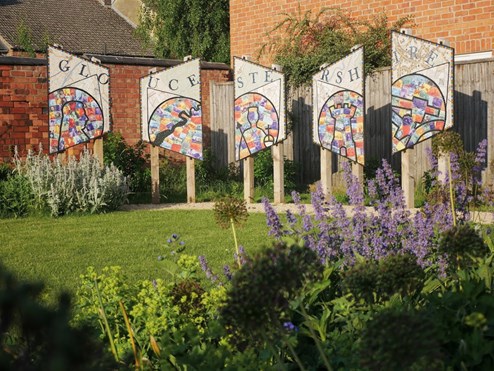
TomatoJack Arts makes artwork using mosaic tiles and is run by artists Angela Williams and Lynda Knott. They have been making mosaics since 2011, independently as well as collaborating at their studio in Berkeley in the heart of Gloucestershire.
Their brief was to illustrate the history of Gloucestershire. A tall order but they rose to the challenge!
During their initial visits to the Archives Angela and Lynda were immediately inspired by the vaults full of old maps and photographs. This sowed the seed for a basic design idea based on a representation of an unfolded map.
Their research began and included visits to care homes across the county (gathering photographs and memories from the residents), as well as speaking to members of Gloucestershire Local History Association and Gloucestershire Family History Society about ‘what’, ‘where’ and ‘who’ should be included.
Angela and Linda were able to collect a huge amount of information; unique photographs and memories of architecture and buildings as well as records of events and activities from the everyday lives of the people of Gloucestershire.
Deciding the best way to reflect the rich and diverse history of Gloucestershire TomatoJack used the photographs themselves within the mosaic design. The photographs were fired onto durable porcelain tiles and these were then used to make the mosaic image.
Although the majority of the mosaic panels were made over several months at their studio in Berkeley, TomatoJack also worked with the staff and volunteers at Gloucestershire Archives. Young people from the Aston Project also came to Archives and tried their hand at mosaic helping to complete the very first panel.
The resulting site specific artwork is based on a representation of an unfolded map detailing in traditional mosaic ceramic tiles the varied geographical features of the large county: towns and villages, motorways and railways, rivers and canals, woodland and forest, hills and contours.
Each of the five panels features a ‘Focus Point’ of a colourful patchwork of photo tiles representing a snapshot of different aspects of Gloucestershire’s history including; Notable People, Events, Places, Industry and Everyday Life. At a distance a silhouette of an image related to each panel can be seen.
The Archivist - Natasha Houseago
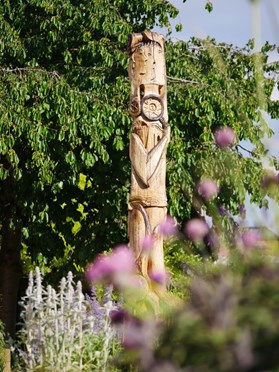
This tall sculpture began life as a large oak tree trunk sourced from a country estate in Oxfordshire.
Once delivered to the community garden Natasha’s first task was sealing the ends of the trunk to keep the moisture in and worms and critters out and to strip off the bark at the base of the trunk ready for it to be placed in the ground. One metre of the trunk is buried in the ground making sure the sculpture is stable and won’t fall over. Over three metres is showing above ground.
Heavy machinery, a large hole, steady hands and some careful bracing were needed to site the trunk in its final position.
Next stage was to remove the remainder of the bark, mark up using chalk and then begin carving. At the end of each day Natasha oiled the carving. This helped to protect the exposed wood and as the oil soaked in overnight to bring out the grain ready to inform the next days carving.
During the autumn of 2018 Natasha was on site for 3 days a week carving the sculpture. The work was very physical and required rest days in between carving days.
Small holes were drilled in the sculpture, Staff and visitors had the opportunity to embed small personal artefacts that held a special memory. Children from the local primary school wrote messages to children of the future. Pegs were driven into the holes to keep the messages and artefacts safe. Natasha finished her sculpture in November 2018, just in time to catch the last of the gorgeous autumn colours.
The sculpture looking fabulous in the bright autumn sunshine.